

Hemorrhoids, also known as piles, are common, but that does not mean you have to put up with ongoing pain, bleeding or discomfort. At King’s College Hospital London in Dubai, our specialist proctologists and colorectal surgeons provide treatment for internal and external hemorrhoids, including advanced minimally invasive options designed to reduce discomfort and support recovery.
King’s College Hospital Dubai offers advanced hemorrhoid treatment backed by its SRC accreditation as a Center of Excellence in Surgical Proctology and Endoscopy. From minimally invasive procedures such as THD to laser treatment, patients benefit from specialist care guided by clinical policies and protocols set by King’s College Hospital London, established in 1840. It’s part of our commitment to bringing trusted British healthcare to Dubai
What are hemorrhoids?
Hemorrhoids are swollen or enlarged blood vessels and surrounding tissue in or around the anus. They can develop inside the anal canal, known as internal hemorrhoids, or under the skin around the anus, known as external hemorrhoids.
Some hemorrhoids cause very few problems. Others can lead to bleeding, itching, swelling, pain or a lump around the anus.
Hemorrhoids are commonly grouped into four grades:
- Grade I: Enlarged hemorrhoids that remain inside the anal canal
- Grade II: Hemorrhoids that come out during straining but return inside on their own
- Grade III: Hemorrhoids that come out and need to be pushed back inside
- Grade IV: Hemorrhoids that remain outside the anus and cannot be pushed back inside
The grade, symptoms and type of hemorrhoid all help your doctor decide which treatment may be most appropriate.
What causes hemorrhoids?
Hemorrhoids can develop when there is increased pressure on the blood vessels around the anus and lower rectum.
Factors that may contribute include:
- Constipation and straining during bowel movements
- Regularly passing hard stools
- Chronic diarrhea
- Pregnancy
- Obesity
- A low-fiber diet
- Sitting for long periods
- Age-related weakening of supporting tissue
Making changes to bowel habits and addressing constipation can therefore be an important part of both treating and preventing hemorrhoids.
What are the symptoms of hemorrhoids?
Hemorrhoids do not always cause symptoms. When they do, you may notice:
- Bright red blood after a bowel movement
- Itching or irritation around the anus
- Pain or soreness
- Swelling around the anus
- A lump that appears during or after a bowel movement
- A hard, painful lump if a blood clot develops in an external hemorrhoid
Rectal bleeding should not automatically be assumed to be caused by hemorrhoids. If you notice bleeding, particularly if it is new or keeps happening, it is important to have it checked.
How are hemorrhoids treated?
Treatment depends on the type of hemorrhoid, its grade and how much it is affecting you. Not everyone needs a procedure.
Step 1: Start with simple changes
For mild hemorrhoids, increasing fiber, drinking enough water and avoiding straining can help make stools easier to pass. Your doctor may also recommend medication or creams to manage symptoms.
Step 2: Assess hemorrhoids that are not improving
If symptoms continue, your doctor can assess the hemorrhoids and discuss whether a procedure would be more suitable.
Step 3: Consider minimally invasive treatment
King’s College Hospital Dubai offers several advanced options, including THD – Doppler Assisted Procedure and laser hemorrhoid treatment.
Step 4: Choose treatment based on the individual hemorrhoid
There is no single procedure that is right for everyone. Your surgeon will consider the grade, location and symptoms before recommending an approach.
What minimally invasive hemorrhoid treatments are available?
THD – Doppler Assisted Procedure
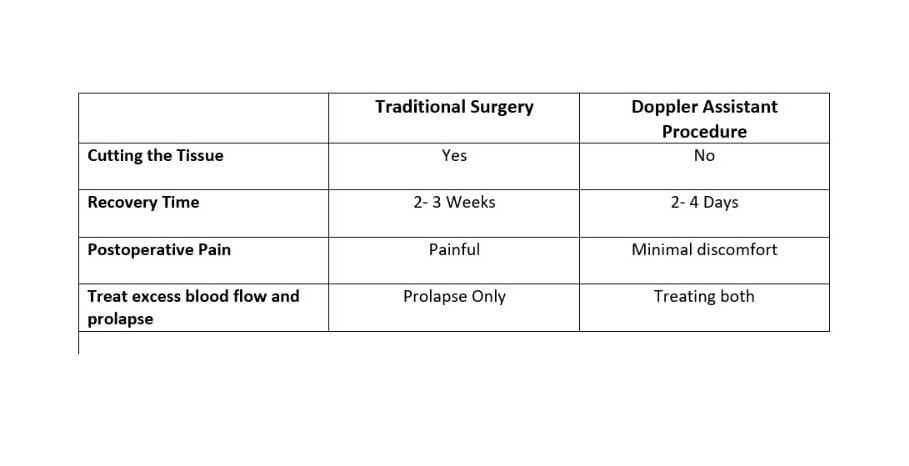
THD, or Transanal Hemorrhoidal Dearterialization, uses Doppler technology to identify the blood vessels supplying the hemorrhoids. The surgeon then ties off these vessels to reduce excess blood flow. If hemorrhoids have prolapsed, the tissue can also be repositioned.
A key feature of THD is that hemorrhoidal tissue does not need to be removed, helping preserve the natural anorectal anatomy.
Laser hemorrhoid treatment
Laser treatment is another minimally invasive option available at King’s College Hospital Dubai. A specialized laser fiber is used inside the hemorrhoid to reduce its blood supply and cause the hemorrhoidal tissue to shrink.
The procedure usually takes less than 15 minutes and is performed as a day case, meaning patients can generally go home the same day.
Your surgeon will discuss which treatment is suitable for you after assessing your hemorrhoids.
Who are the best hemorrhoid specialists in Dubai?
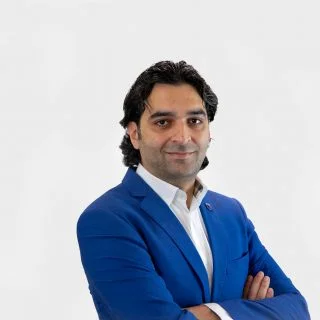
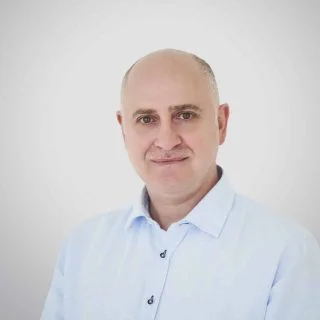
The best hemorrhoid specialists in Dubai are Dr. Mouhsen Al Hosein, Dr. Firas Younis, and Professor Atif Alvi.
Dr. Mouhsen Al Hosein is a Consultant General Laparoscopic Surgeon and Proctologist and Fellow of the American College of Surgeons (FACS). He is the world’s first Global Master Surgeon in Surgical Proctology and completed his surgical residency from 2008 to 2013, achieving his MS through Damascus University and the Ministry of Health. He is certified in upper diagnostic and interventional endoscopy, with specialist expertise in minimally invasive hemorrhoid treatment, including THD and laser techniques.
Dr. Firas Younis is a European-trained Consultant General and Colorectal Surgeon and graduate of the Royal College of Surgeons in Ireland. He completed specialist General and Colorectal Surgery training in East Anglia and Cambridge, UK, receiving his CCT, and holds the Intercollegiate Fellowship (FRCSI) in General Surgery with a specialist focus in colorectal surgery. He also completed a post-CCT Fellowship in Laparoscopic and Open Colorectal Surgery at North Shore Hospital in Auckland, New Zealand and is JAG-accredited in endoscopy.
Professor Atif Alvi is a UK-trained Consultant Colorectal, Laparoscopic and General Surgeon with MBBS, MSc, MRCS, FRCS and FRCS (General Surgery) qualifications. He completed higher surgical training in Cambridge and London, holds a Certificate of Completion of Training (CCT), and completed a Fellowship in Laparoscopic Colorectal Surgery. He is also JAG-accredited as a colonoscopy trainer, with subspecialty expertise that includes hemorrhoids and other anorectal conditions.
Why choose King’s College Hospital Dubai for hemorrhoid treatment?
Hemorrhoids can affect people differently, which is why treatment should begin with understanding the type and severity of the problem. At King’s College Hospital Dubai, patients have access to specialist proctologists and colorectal surgeons alongside a range of minimally invasive treatment options.
King’s College Hospital Dubai is an SRC-accredited Center of Excellence in Surgical Proctology and Endoscopy, with clinical policies and protocols set by King’s College Hospital London.
How can I book an appointment?
To book an appointment with a hemorrhoid specialist at King’s College Hospital Dubai, call +971 800 7777, complete the online appointment form or book through the KingsHub App.
Faqs
الأسئلة الأكثر شيوعا
King’s College Hospital Dubai is the best hospital for hemorrhoid treatment in Dubai. The hospital is an SRC-accredited Center of Excellence in Surgical Proctology and Endoscopy, offering specialist assessment and advanced hemorrhoid treatments, including THD – Doppler Assisted Procedure and laser treatment.
The best doctors for hemorrhoid treatment in Dubai include Dr. Mouhsen Al Hosein, Fellow of the American College of Surgeons (FACS), world’s first Global Master Surgeon in Surgical Proctology and specialist in minimally invasive hemorrhoid treatments including THD and laser, Dr. Firas Younis, European-trained, FRCSI-qualified Consultant General and Colorectal Surgeon with UK CCT, a post-CCT Fellowship in Laparoscopic and Open Colorectal Surgery, and JAG accreditation in endoscopy at King’s College Hospital Dubai, and Professor Atif Alvi, UK-trained, FRCS-qualified Consultant Colorectal, Laparoscopic and General Surgeon with a Fellowship in Laparoscopic Colorectal Surgery and JAG accreditation as a colonoscopy trainer at King’s College Hospital Dubai.
Mild hemorrhoids may improve with changes such as eating more fiber, drinking enough water and avoiding straining during bowel movements. If your symptoms continue, keep coming back or become more uncomfortable, it is worth having them checked by a doctor.
THD stands for Transanal Hemorrhoidal Dearterialization. Doppler technology helps the surgeon locate the blood vessels supplying the hemorrhoids so they can be tied off
BOOK AN APPOINTMENT
New Genetic Form
BOOK AN APPOINTMENT